
Direction approved. The menu goes from six entries to three.
Menu, homepage and three templates were reviewed. The design is kept: the feedback is about the menu and the content, and it is written into this page. The menu was redrawn on 24 September on the new baseline, to be confirmed at the Paris workshop. The other screens predate the review.
Industries and business functions lead the menu, so a visitor recognises their own problem before reading our offer.
Three entries, not six. Fewer doors to learn, and a structure the content team can keep alive.
Industry pages stay short. The depth comes from the use cases linked to them, not from long static pages.
The manifesto hero, the four capabilities, the HOM block and the business functions. The animation is not in the mockup: the hero background reacts to the mouse, in the manner of the Stripe homepage, and is what keeps a visitor on the page.
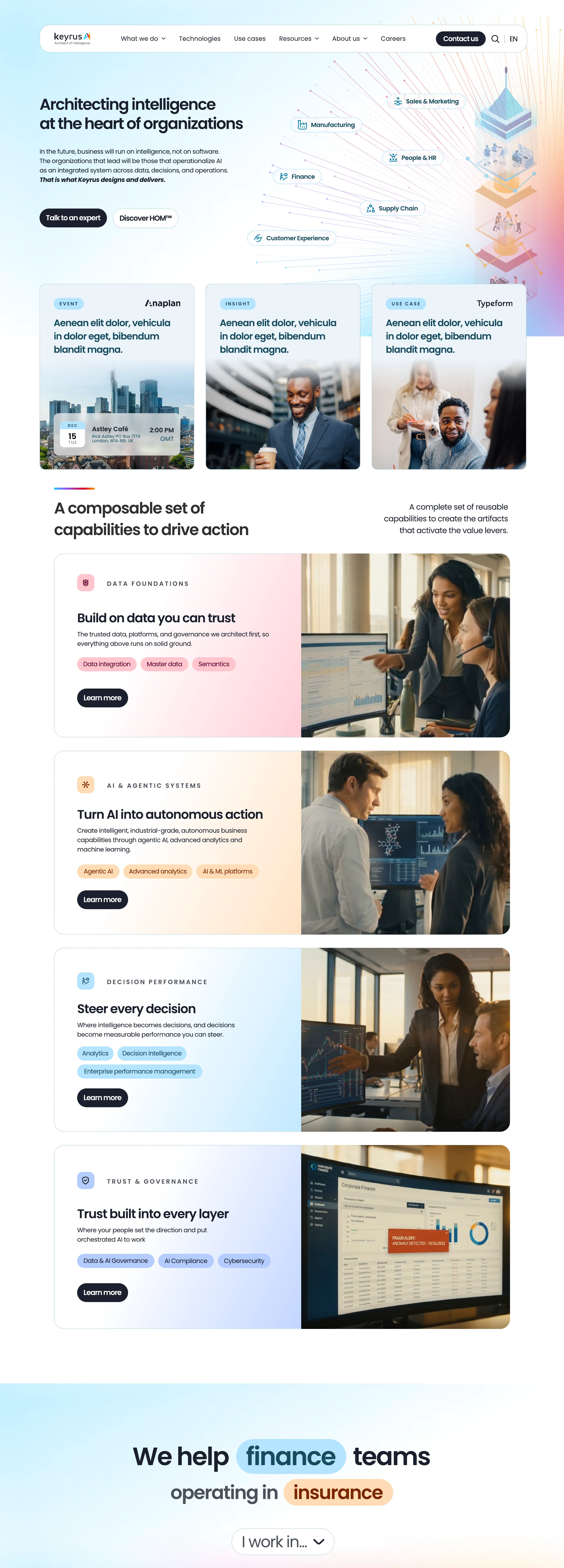
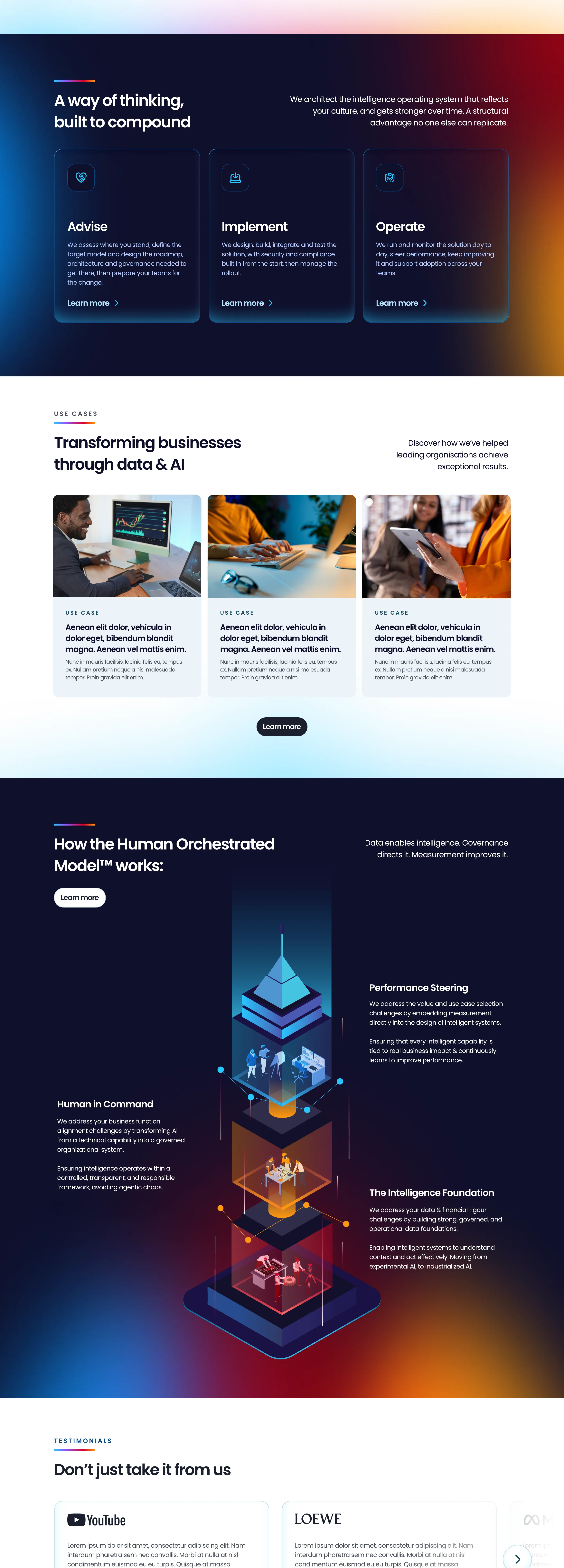
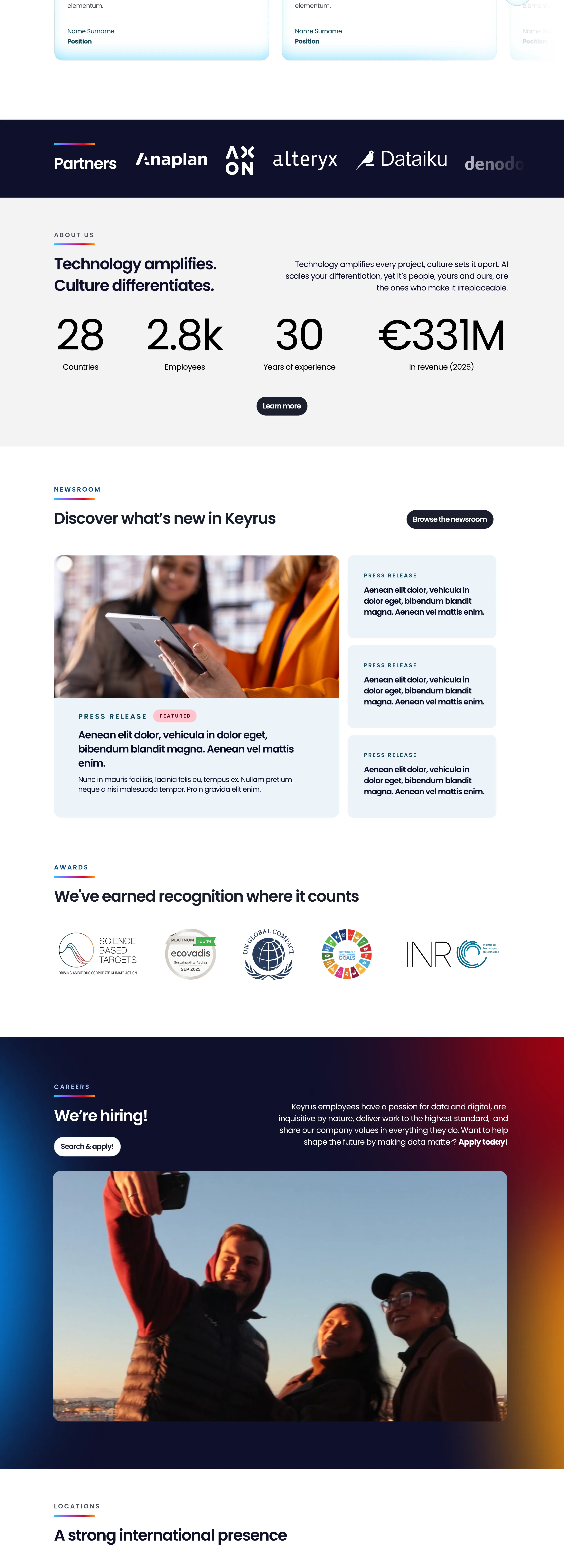
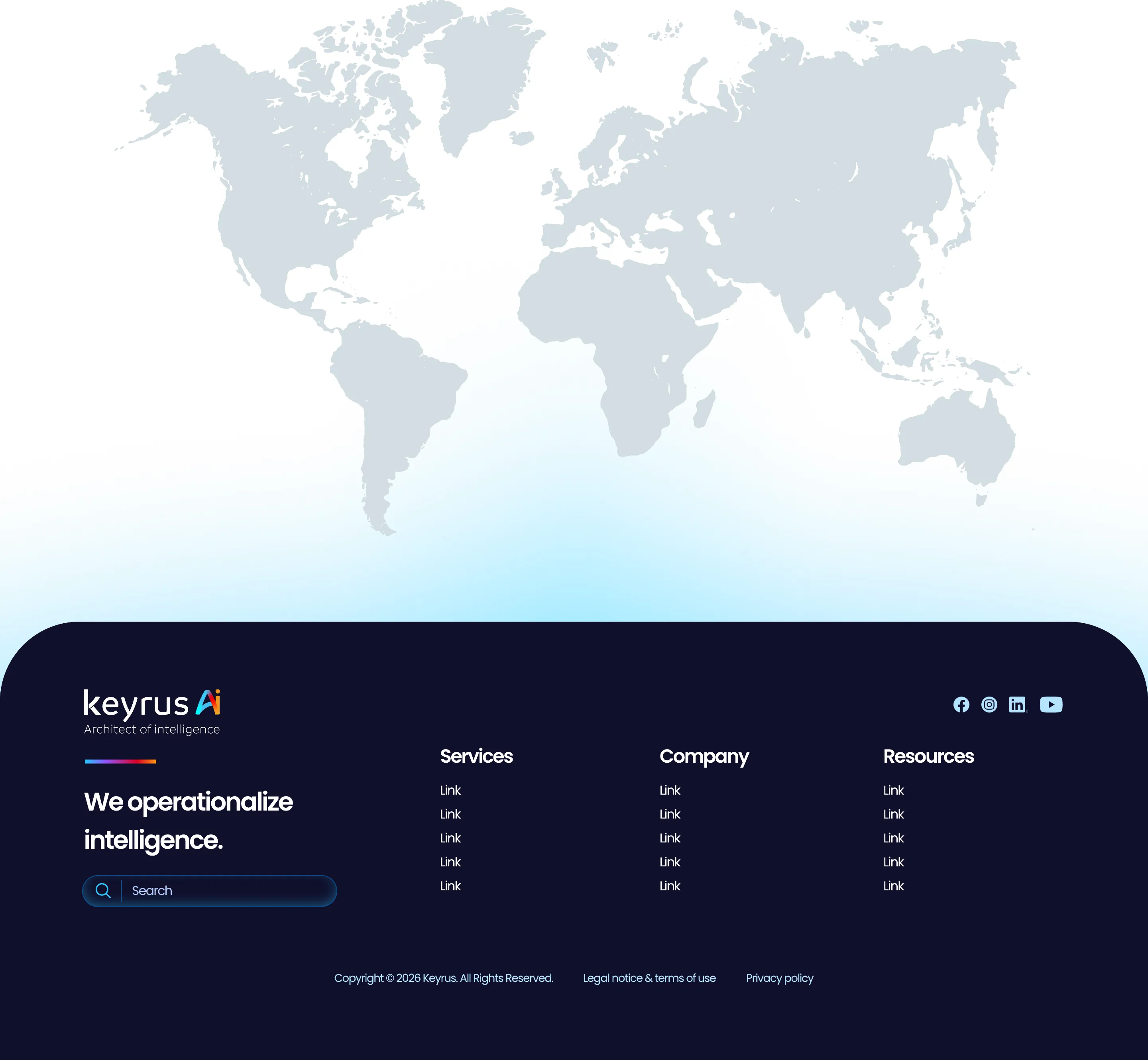
- Three dynamic cards added at the fold. Event, insight, use case. They answer the question the hero did not: what makes a visitor scroll. They are meant to be localised, so each country surfaces its own events, campaigns and publications.
- The client logo row is out. It took the space the cards now use.
- The HOM visual was shortened, not removed, to make room. Its full display stays on the HOM page.
- Still open: the cards carry images. The session agreed on text only, a title plus a one-line description, precisely because thumbnails and headers are not design-governed yet and a weak thumbnail would land in the most visible place on the site. The export keeps the images. Either we govern the templates with group marketing, or we go text only.
- Still open: the order of the page. Raised in the review: show use cases, the tangible proof, before the capabilities.
Three templates carry every page of the site
Validating these three is what releases content production. The rest of the site reuses them: eight industries on the industry template, four capabilities on the capability template, the four Loop stages on the services template (the stage layout is still to design). What changes afterwards is the copy, not the design.
Capabilities
Full size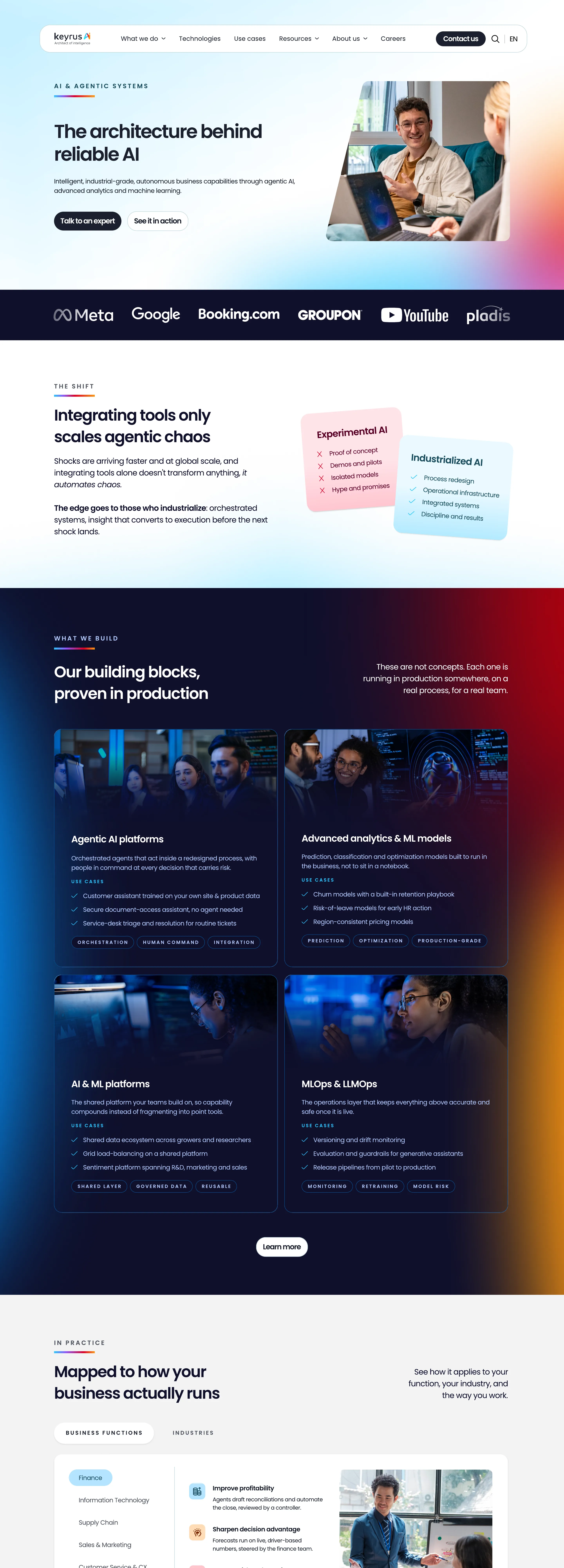
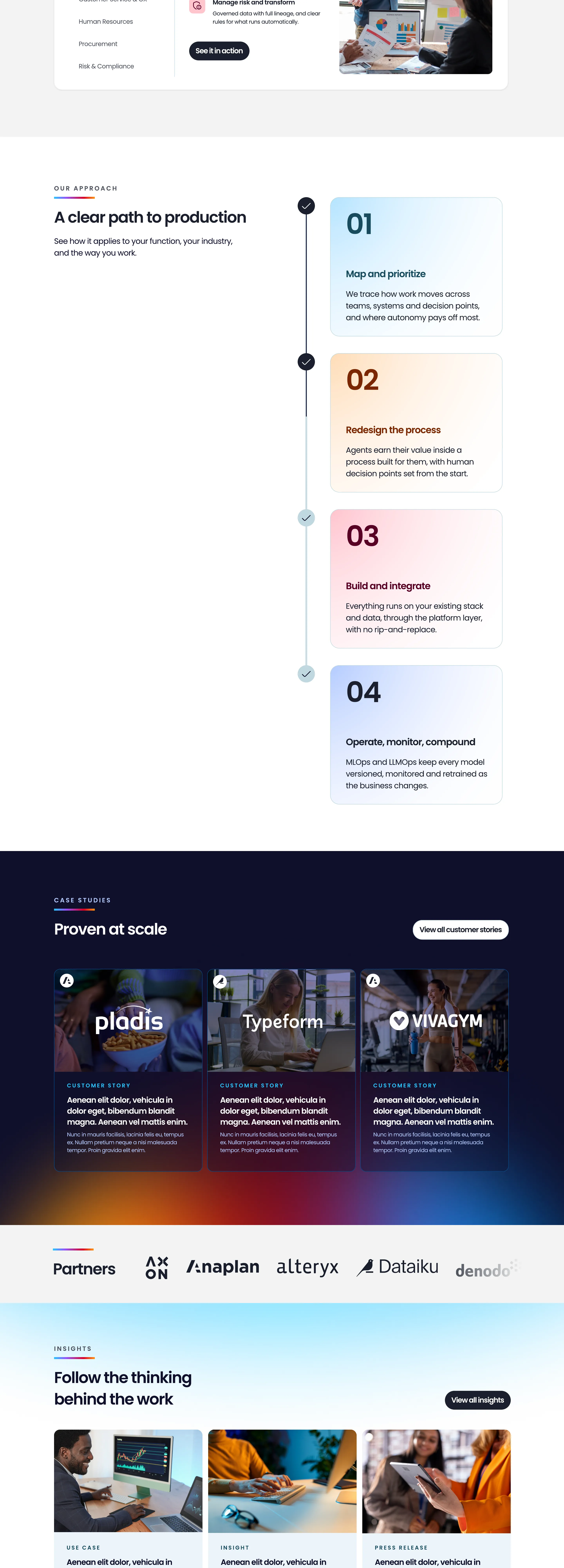
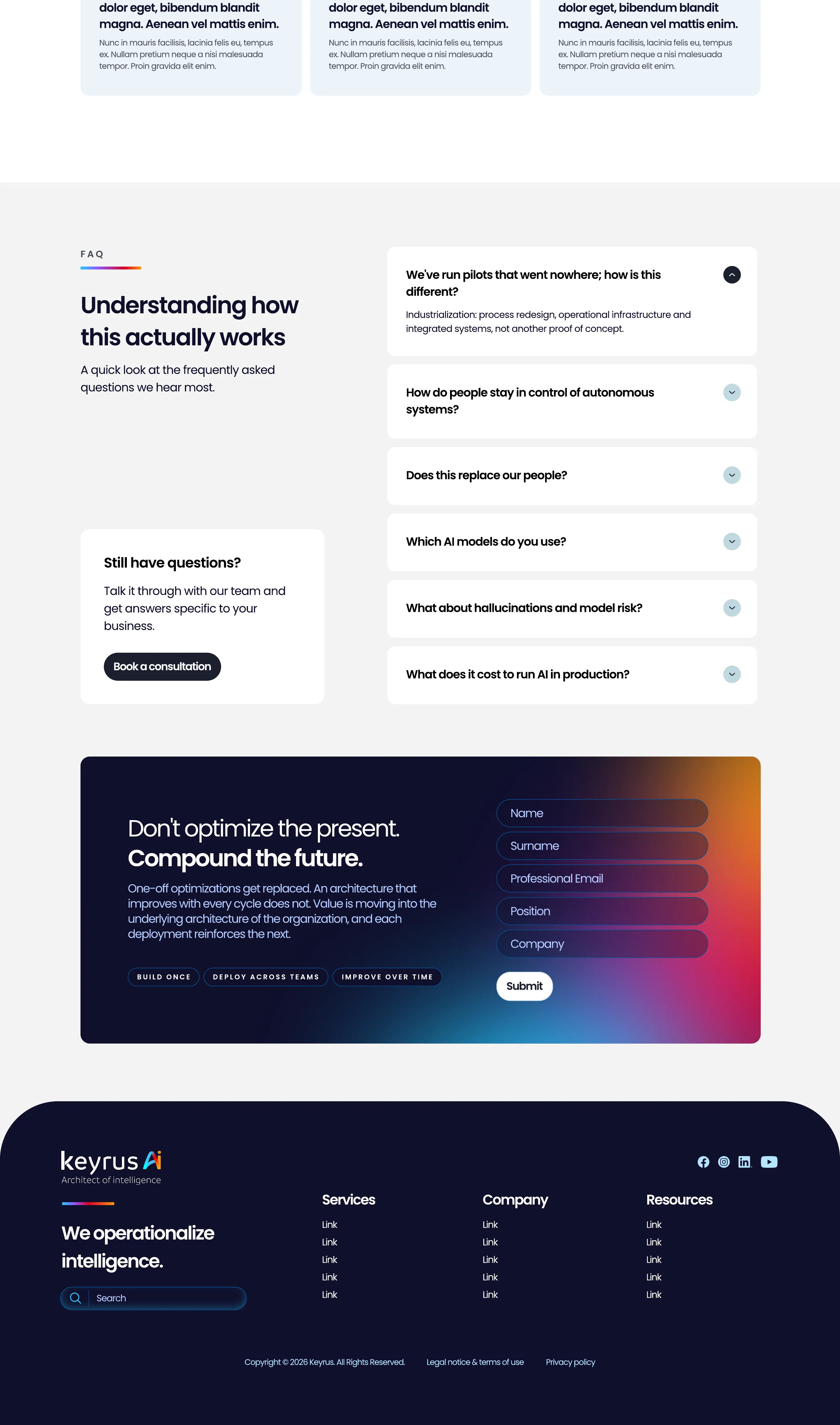
Industry
Full size
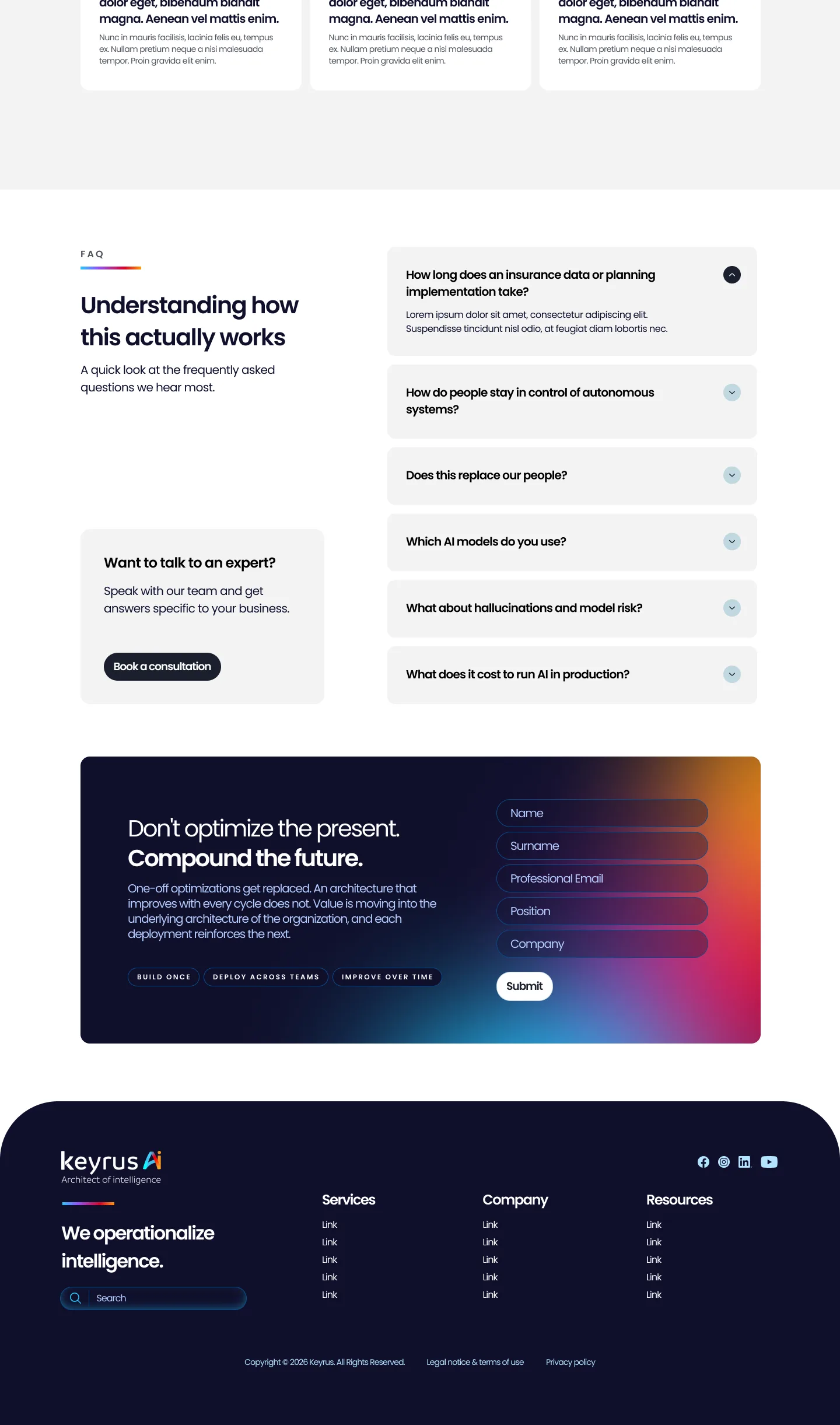
Services
Full size
Capture before 8 October: old services model, three sibling pages. The four Loop stages on one template are still to design.
- A short page. An intro, then the five value levers of the portfolio, each with named use cases. Not an encyclopedia of the industry.
- Depth through links. The use cases, insights and references attached to the page carry the detail, and they stay current where a static page would not.
- Content in two steps. A first version drafted by the team from analyst studies and validated by the executives, then one named expert per industry and business function over the following six months.
From the review to the release on 3 December
Architecture, templates and most of the content are already produced. That is why a December release is reachable: the review was a validation, not the start of a production phase.
Menu baseline agreed and redrawn on 24 September. Next: the executives review the twenty screens in full.
On the new preprod, keyrus-ai.netlify.app, with demo content. Code review and CMS review done.
Final content loaded first, then the SEO pass, the template finishing and the test rounds. Dates per step to set.
Target confirmed by development on 26 October. Status 26 Oct
All twenty screens at full height: the rest of the structure, the country and contact pages, and the seven editorial templates. For the questions this session does not cover.
The website, our top marketing driver of business.
The keyrus.com redesign is not a cosmetic project: it's the marketing asset that generates the most pipeline. Every call in this plan serves three optimizations: UX (conversion), SEO (organic traffic) and GEO (visibility in generative AI answers, where the structured HOM narrative becomes a direct advantage).
Architecture, templates and most of the content are already produced
This is the single most important fact in this plan. Jesse and Chanti have produced the menu architecture, the page templates and the bulk of the content; the Keyrus AI manifesto copy has been live on the dev instance since 6 July (43 entries, 508 fields, 7 languages). The 18 September gate is therefore a validation, not a production phase, which is what makes the December release reachable.
| Surface | What exists today |
|---|---|
| Menu architecture | Three entries after the 18 September review: What we do (industries, business functions, capabilities, technologies, services), Insights, Who we are. Redrawn on 24 September |
| Design | Twenty screens exported on 18 September: menu, homepage with the reworked above the fold, five reusable templates and the seven editorial templates. See the board |
| Page templates | One concept per page type, produced across the structure |
| Homepage | newHomepage published, manifesto copy in place |
| Services / Offers | 5 topServices and the new offer format |
| Industries | Insurance pilot, complete and rich: approach, 6-step methodology, use cases, insights. 13 industries since 23 October: 8 in expert review, 5 in a second wave with starting documents |
| About Us | Manifesto copy live in 7 languages |
| Content | 1,087 existing content items audited and mapped to the HOM layers |
Preprod, updated 26 October: keyrus-ai.netlify.app, built in Next.js and connected to the
keyrus-ai
Contentful environment. It replaces the former dev instance, keyrus-redesign.netlify.app on development-3. Status of each page: Status 26 Oct.
From validation on 18 September to release on 3 December
Proposed sequence, to be adjusted and signed off. Validation steps, then development, then the full delivery track: alpha, UAT, a beta phase with its own UAT layer, and a production rollout. Development is 15 working days, Monday 21 September to Friday 9 October. Scroll the chart horizontally on narrow screens.
Exec validation cadence
Run by Stephan and Christophe, roughly every two weeks. The Shift workshop in Paris is the one in-person gate, with all Shift leaders.
Validation process, in order
Click a step for its owner and validation loop.
Four people join the setup in September
On group marketing, on the content that is not industry specific, and on customer references. Industry experts are mobilised per industry once the template is validated.
Joining
Joins at group level; remit communicated shortly. Global versus local and the satellite sites are both group marketing calls.
Own the content that is not industry specific: the portfolio and the HOM, which is the global layer of decision D10.
Customer success stories and references: the proof layer the positioning is missing.
One pairing per industry, mobilised once the industry template and wave 1 are confirmed (D3, D4).
In place
Validate at each gate, run the exec cadence, and carry the decisions to Eric Cohen and Marc Stukkens.
Drives the plan and the Contentful instance, follows the development track and challenges the technical choices.
Menu architecture, page templates, content matrices, and the audit of the 1,087 content items mapped to HOM.
Design of the new surfaces, image direction, mockups, produced alongside the page structure rather than after it.
Build on the instance, test pass and production cutover.
Briefed during the build, then the final go/no-go on 2 December before general release.
Who produces what, with which dependencies
The critical path runs through the 18 September validation: it releases development and the remaining content production. Most workstreams are already well advanced, so what follows is mostly finalisation and sign-off rather than production from scratch.
| Workstream | Scope of work | Dependencies | Owners | Milestone |
|---|---|---|---|---|
| Menu architecture | Three-entry baseline from the 18 September review: industries first, technologies and services inside What we do, use cases and resources merged into Insights, a featured customer story in the dropdown | Redrawn 24 Sep · confirm at the Shift workshop | Jesse · Chanti | → Sep 29 |
| Page templates | One template per page type, then rollout across all pages | Produced · Contact Us concept pending | Jesse | → Sep 18 |
| Homepage | Manifesto hero, HOM block, taglines, image selection | D1, D6 · copy already live | Baptiste · Chanti | Sep → Oct 8 |
| Services / Offers | New offer format, naming against the 4 capabilities | D2 | Jesse · Baptiste | Sep → Oct 8 |
| HOM | Building the HOM surface: content, design, links to offers and portfolio | D1 · D10 for the global layer | Brahim · Christophe · Baptiste | Sep → Oct 8 |
| Portfolio | Cases rewritten in HOM format, duplicates removed, quantified proof per layer; priority on the audit's blind spots; cybersecurity by design made explicit in Trust & Governance | D9, D10 · cases supplied by the practices | Brahim · Christophe | → Oct 8 |
| References | Customer success stories, the proof layer for L2 Human in Command | Client approvals | Catherine | → Oct 8 |
| Industries | Short pages: five value levers with named use cases. First version drafted by the team, then one expert per industry over six months | D3, D4 | Jesse + industry experts | Sep → Oct 8 |
| About Us | Structure reformat; the manifesto copy is already live in 7 languages | D5 settled | Baptiste · Jesse | → Oct 8 |
| UX & creative | Experience, image selection, validation via Shift: homepage, portfolio, HOM, menu | D7 settled · Shift workshop 29 Sep → 1 Oct | Chanti · Baptiste | → Sep 25 |
| Contentful integration | HOM content model, taxonomy tags, placeholder cleanup, services title repositioning | D9, D10 · all content validations | Baptiste · Erwan | Sep → Oct 8 |
| Development | Web integration, QA, alpha, UAT, beta, production cutover, comms plan | Sep 18 validation | Erwan · Baptiste | Sep 21 → Dec 3 15 working days to alpha |
6 decisions still open, 5 already settled
Choices and comments are saved live in this browser, and the summary copies in one click for the write-up. Recommendations are proposals from the project team.
Group-level decisions
Eric & KarenThese two outlive the redesign. They are brand and governance calls at group level, not website structure calls, and they change what the site has to support before templates are rolled out across every page.
Website decisions
Stephan & ChristopheStructure and content calls inside the project. Four of them have been settled by the work already done since July and are kept here for the record rather than reopened.
Fourteen more, outside the numbered decisions
Flagged on the ClickUp sitemap rather than in the decision list. They are structural and editorial calls that the mockups cannot answer on their own. The menu shared on 8 September already settles one of them.
- StructureTwo sitemap blocks flagged Can these be consolidated?
- StructureResources to collapse into a single page. The menu shared on 8 September already does this: Insights carries Videos, Events and Customer Stories & Use Cases.
- StructureSome sections will not be pages of their own.
- ContentfulOne page or several to find content? Asked with an explicit doubt about what the CMS can do. It governs the four filters.
- PartnersGroup partners by HOM layer instead of alphabetically? The industry pages already do it, with an Engines row under each capability.
- EditorialThe three matrices still have to be produced. Nothing renders properly without them.
- LanguagesHow much gets translated: the whole site, or the core?
- Design governanceWho controls the thumbnails and headers that will surface in the homepage cards? Raised on 18 September by Jesse and Chanti. The mitigation on the table is centralised templates plus closer work with group marketing. Until it exists, the cards should carry text only.
- LocalisationThe homepage cards are localised per country. Who publishes into them, with what editorial rule, and what happens in a country with no event that month? Christophe: it should carry insights, news and campaigns, not events only, or the block goes stale.
- ProcessFocused ownership instead of full attendance. Raised by Baptiste on 18 September: with a fixed deadline, an executive room where everyone arrives with their own approach slows every round. One focus per person, Brahim on portfolio, Catherine on use cases, with this app as the shared level of view. To settle with Christophe and Stephane before the Paris workshop.
- MenuA visible client entry? The three-entry baseline puts use cases and customer stories inside Insights. On the table: a curated Clients entry that opens the use case index filtered on customer stories.
- LabelsVideos names the format, not the message. Demos or Media proposed.
- HomepageShow use cases before capabilities in the homepage order?
- PortfolioCybersecurity by design to be made explicit in the Trust & Governance capability. Brahim, with the portfolio.
Delivery model: the Loop replaces Advise · Implement · Operate
Stage names to confirm.
- DecisionThe Loop replaces the three-step delivery model: Advise, Build, Embed, Prove (names from the portfolio of 19 October; Diagnose, Activate, Orchestrate, Prove on 8 October), carried by one team with five roles and no handoff. Stage names to confirm. Source: SHIFT pre-read, Pillar 1 v2, a proposal for discussion.
- NearshoringOpen. The mockups show nearshoring as a transverse element, with no page and no menu entry. Whether it gets a dedicated page is to settle. Nearshoring covers who staffs the Loop team, adapted by country.
- ServicesThe menu label stays Services, to confirm. The page for each stage is to design: no screen exists yet.
- ScreensThe Services captures (services-0, menu3-services and the board thumbnail) predate 8 October and show the old model. They are not regenerated.
Five reusable templates, now spread over twenty screens
Produced by Jesse and Chanti, exported on 18 September: the thirteen mockups of 8 September plus the seven editorial templates, and a reworked homepage. Offer copy is written and final, editorial copy is still lorem by design. What follows is the reading, the defects and the calls it leaves open.
Twenty screens scrollable at full height, the mega-menu panels grouped by what the executives see and what sits behind it. Rebuilt on the 18 September export, and this is the link to share.
The above the fold, settled on 18 September
The one design point that was still open going into the executive review. Christophe had raised it twice: the hero is beautiful, and nothing on it makes you want to scroll beyond the wow effect.
Unlike Stripe, where the fastest thing a visitor needs is what the product does, Keyrus is bought on customer feedback, testimonials, insights and events. The most recent work is the proof that HOM works, and it is what shows a living company rather than a static one.
Chanti: overload makes visitors scroll away rather than down. Jesse: thumbnails and headers are not design-governed, so a weak thumbnail would land in the most visible place on the site.
Animated hero kept. Client logo row removed. HOM visual shortened, full display kept on the HOM page. Three cards added: event, insight, use case, localised per country so each subsidiary surfaces its own events and campaigns.
The session agreed on text only, a title plus a one-line meta description, precisely to neutralise the governance gap. The 18 September export keeps the images. Either the templates get governed with group marketing, or the cards go text only.
The four structural shifts
Replaced by four languages: worldwide English, French, Spanish, Portuguese. Countries survive as rich pages inside one site. Confirmed on 8 September: strong core, local news, campaigns and events.
The house term gives way to the market’s. Use cases become a content type of their own, with cards, tags and a listing.
Capability × function or industry × business outcome. The home selector and the In practice block render them on screen.
Capabilities, Business functions, Industries, Technology. Tag every item on all four, or the listings come up empty.
| Page | Template | What it proposes | Height | Count |
|---|---|---|---|---|
| Home | Main page | Opens on a thesis, not a service list. Four doors into one catalogue: capability, role and sector, engagement mode, proof. The “I work in…” selector is the only live element. | 13,020 px | 14 sections |
| Services | Offer · four Loop stages (to design) | One template for the four Loop stages: Advise, Build, Embed, Prove (portfolio of 19 October). The capture shows the old model, with its “YOU ARE HERE” badge between three sibling pages, and predates 8 October. The first FAQ meets the consulting objection head on. | 7,620 px | 9 sections |
| Capabilities | Offer · shown as AI & Agentic Systems | Built against pilot fatigue. “In practice” is the only place on the site where the content matrix is rendered: eight functions, three benefits each, twice over, for each of the four capabilities. | 10,443 px | 10 sections |
| Industry | Offer · shown as Insurance | The only page that opens from the client’s business rather than the offer. Solvency II, IFRS 17 with CSM tracking, DORA, ORSA. This is where the cost of the redesign sits. | 10,443 px | 5 outcome levers |
| Customer Stories | Proof · listing | Named customer stories and anonymous use cases share one page. The Keyplays rename made concrete, and the first appearance of the four-facet taxonomy. | 5,468 px | 2 collections |
| Customer Story | Proof · detail | The client comes first: their photograph, their logo, no Keyrus in the header. The body is identical to the Insight article template. | 10,000 px | Shared body |
| Partners | Proof · single page | Deliberately plain, a reference page rather than a sales page, yet top-level in the navigation. | 2,348 px | 20 partners |
| Insights | Content · listing | Refuses the thought-leadership promise. A door into the filter engine: all the value sits in the taxonomy. | 3,654 px | 4 filters |
| Article | Content · detail | The author sits on the image, with a precise role. A comparison table is built into the template, so the writing has to fill it. | 6,479 px | 3 body sections |
| Videos | Content · listing | Same template as Insights with one swap: Capabilities gives way to Type. The featured section is “On replay”. | 3,654 px | 3 formats |
| Events | Content · listing | The only page filtered by time and geography. Hosted by Keyrus against Sponsored is shown on the card itself. | 3,754 px | 2 event types |
| About Us | Company · group page | Owns the double identity, and is the only place the HOM gets its full definition. Leadership shown as a constellation. | 6,979 px | 4 values |
| France | Company · country page | The concrete answer to killing the regional sites, and the only mockup filled with real content. Also the highest-maintenance page on the site. | 8,139 px | 11 named leaders |
Fix before it goes outside
Six placeholder slips carried by the mockups. None of them is a design problem; all six are copy that was never written or was pasted twice. Re-checked against the 18 September export: the About hero still reads “Talk to our insurance team”. The other five have not been re-verified screen by screen and should be before development starts.
- IndustryAI & agentic systems repeats the Data foundations bullets, word for word. Its own copy was never written. The rewrite is drafted in Capabilities by page v1.
- AboutThe hero button still reads Talk to our insurance team.
- AboutThe Collective intelligence card repeats the hero standfirst.
- AboutAll three HOM layers carry the same description. The industry page gets it right.
- PartnersAxon Technologies is captioned twice, once under the Dataiku logo.
- FiguresTwo formats for the same numbers: 28 / 2.8k / €331M against 30+ / 2,800+ / €331.7M.
Pre-plug the default, then give the experts one week to correct it
Two documents dated 26 August cover all sixteen pages: Outcome levers by page v2 for section 02, Capabilities by page v1 for section 06. Between them, 80 outcome rows, 380 action levers and 256 capability points, all counted against their character limits. Nothing here is a placeholder.
Browse the drafted content
Open a page to read its five outcomes with their value lever line and action levers, then the four capability cards with their points and engines. This is the copy the experts are asked to correct.
Who owns which page
The mapping that has to exist before the window opens. Names are typed here and kept in this browser; the summary copies out for the chat.
| Page | Type | Card copy on the tab | Expert | Status |
|---|
Verification queue
Twenty-three items the drafts flag themselves, most of them regulatory names or partner engines. Legal review applies to every regulation named, and partner tier wording is unconfirmed everywhere. S02 is the outcome levers element, S06 the capability cards.
Twelve calls that apply to every page
Raised by the two documents themselves. They are resolved once and applied across the set, so they belong in the 18 September session rather than with the individual experts.
Three top-level entries, the baseline from the executive review
The 18 September export had six entries. The executive review cut it to three: What we do, Insights, Who we are. What we do opens on Industries and now holds Technologies and Services. Use cases and resources merge into Insights. HOM, the group pages and Careers sit under Who we are. Chanti redrew it on 24 September, and it is confirmed at the Paris workshop.
01 · What is inside it
The menu rebuilt, so you can open it. One panel at a time behaves like the real thing. Everything open gives the whole architecture on one screen, which is the view the menu itself never provides.
02 · Why it is arranged this way
Each panel carries its own justification. What follows is what the executive review closed, and what it leaves open.
Settled by the executive review 7
- Industries lead : What we do opens on Industries, then Business functions, then Capabilities. The client recognises their challenge before reading our offer.
- Services stay, last : not a differentiator, since everybody advises, builds and operates. But a visitor who does not know Keyrus needs to see that we advise as well as build.
- Technologies moves into What we do : at the top level it was too prominent. The page maps partners onto the four capabilities and shows Keyrus’s own assets, the AI operating system included.
- Insights : use cases and resources merged into one entry, which keeps the bar to three.
- Who we are : About us and Careers together. HOM keeps its own page there, as the root of the services rather than one of them.
- A featured customer story in Insights : visible as soon as the panel opens, so a visitor sees what we deliver without clicking.
- Count and naming : eight industries, not nine. IT and Workforce Management, not “Information Technology” and “Human Resources”. Unchanged since 8 September.
Still open after it 7
- A visible client entry : customer stories sit inside Insights in the baseline. One option: a curated Clients entry that opens the use case index filtered on customer stories.
- The Videos label : names the format, not the message. Demos or Media proposed.
- What we do or How we help : raised by Christophe. Easy to change, so not a blocker.
- Service naming and copy : the Loop replaces the previous three-step model, so the menu and the offer template no longer read alike by design. The Services menu label stays, to confirm. The three service cards still carry EPM copy (“enterprise planning solutions”, “training for Anaplan users”) and are to be rewritten as the four stages. Decision D2, which listed four items including Managed Services and Nearshoring, no longer applies to the three-step model. Where nearshoring sits is to settle.
- No About us entry : the HOM card now carries “our purpose, our difference”. What sets us apart, Brands and Newsroom no longer appear. Brands was the home the satellite brands were given on 8 September and it feeds decision D11. Confirm this is intended.
- Investors : the card reads “Company news, announcements and media coverage”, which describes a newsroom, not an investor page.
- Scope : one level of depth only. No mobile state, no search behaviour, no language switcher behaviour. Still to be specified before development.
The panels, as designed
Redrawn by Chanti on 24 September, on the three-entry baseline. The live menu above carries the same content.

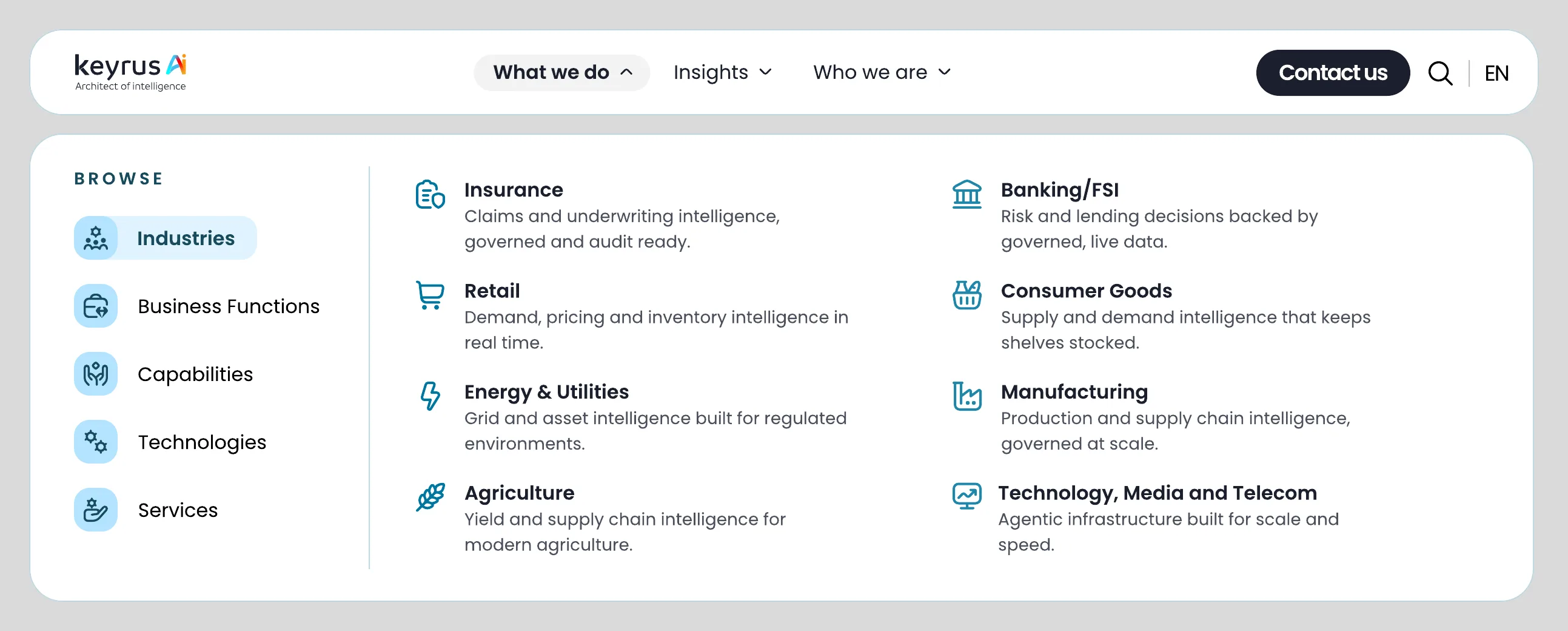
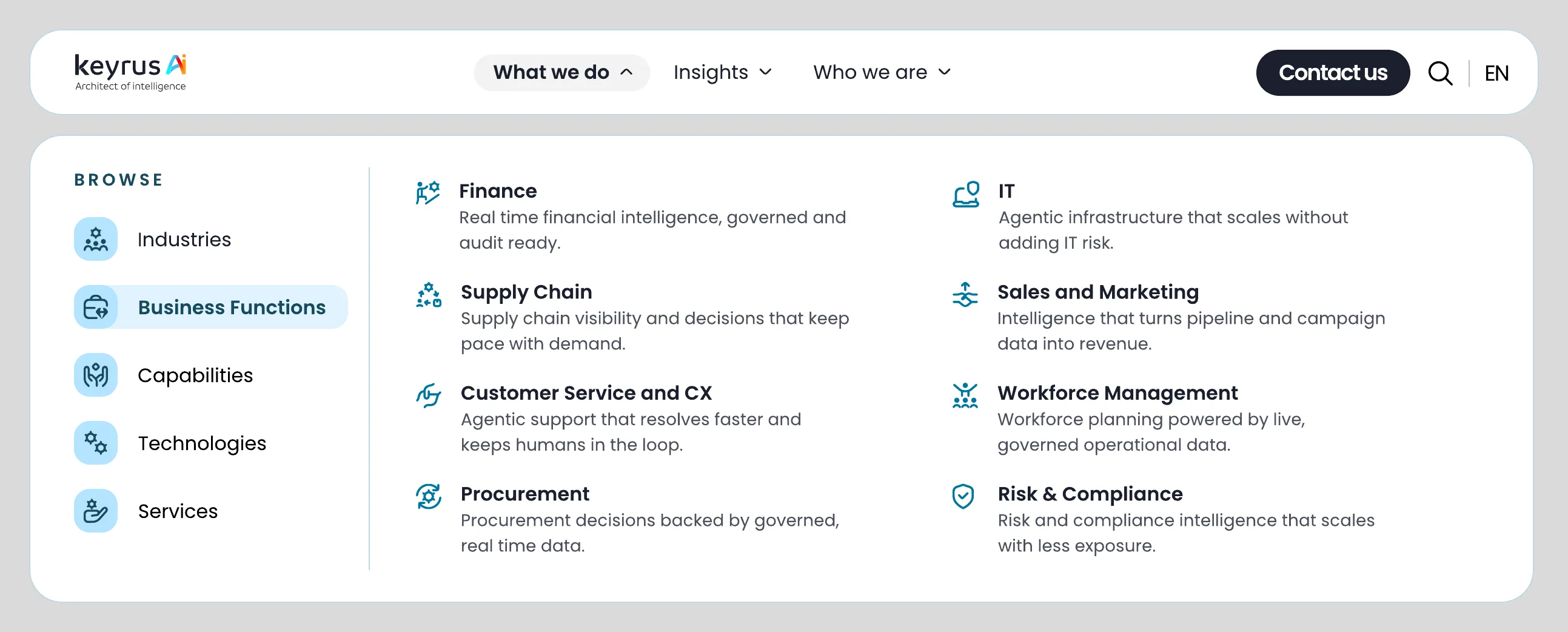
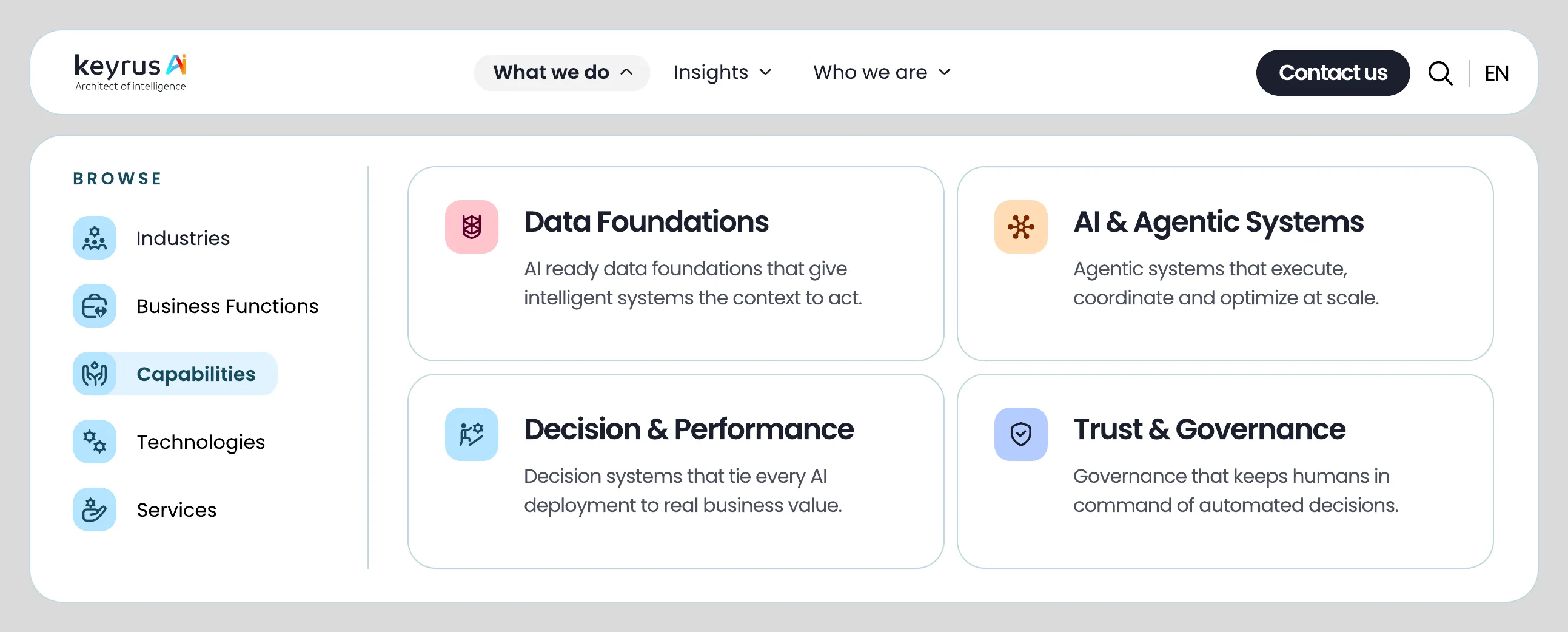
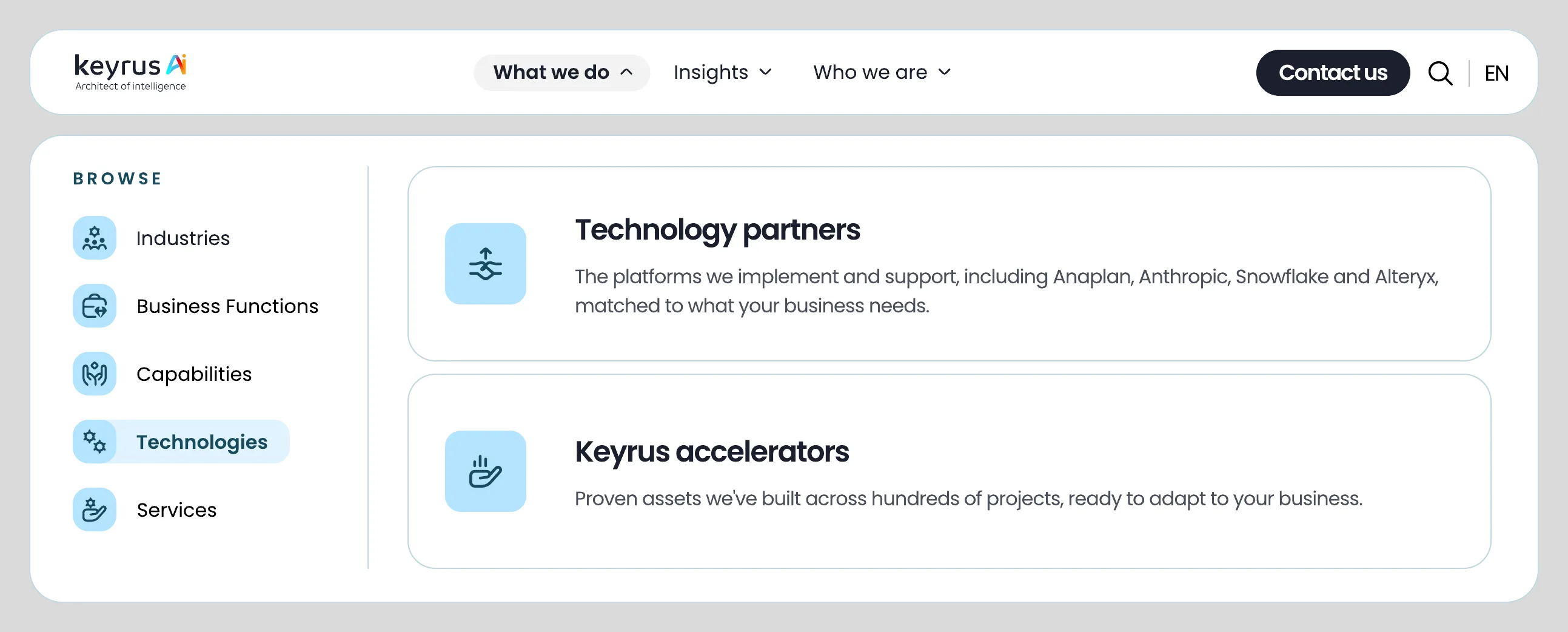
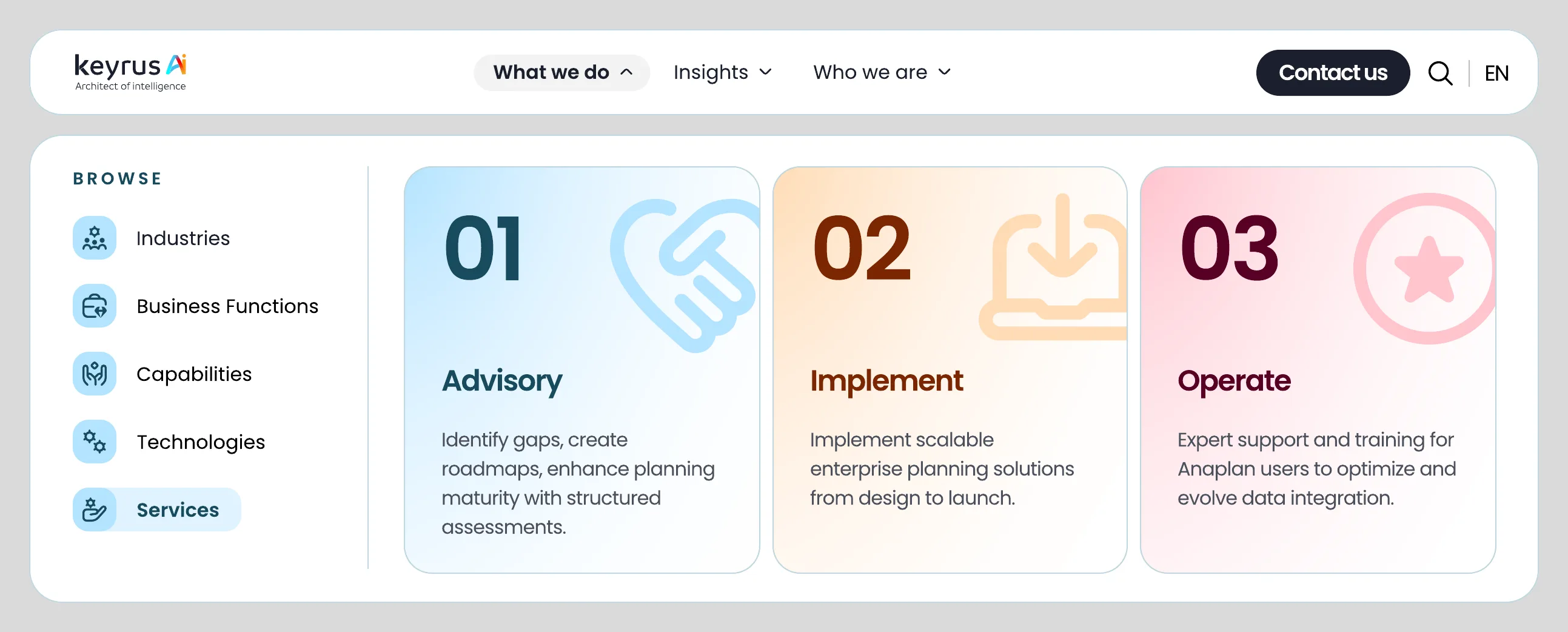
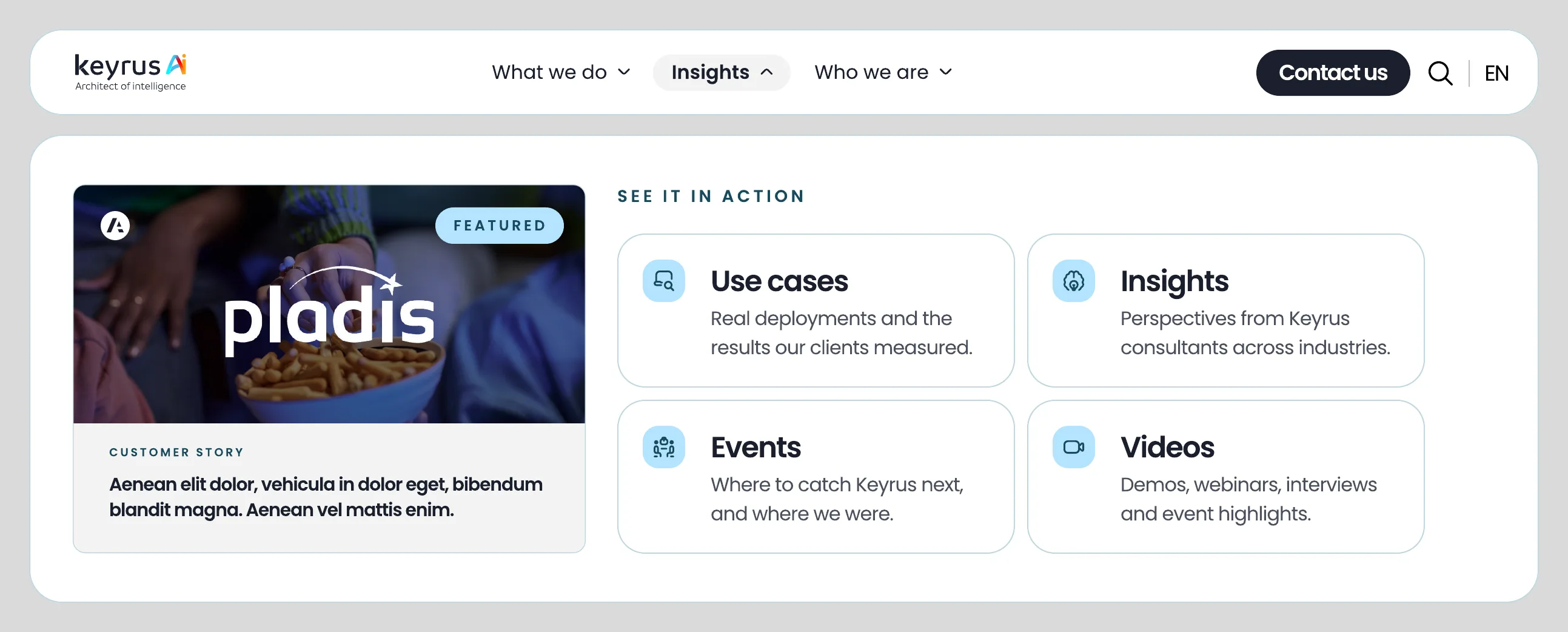
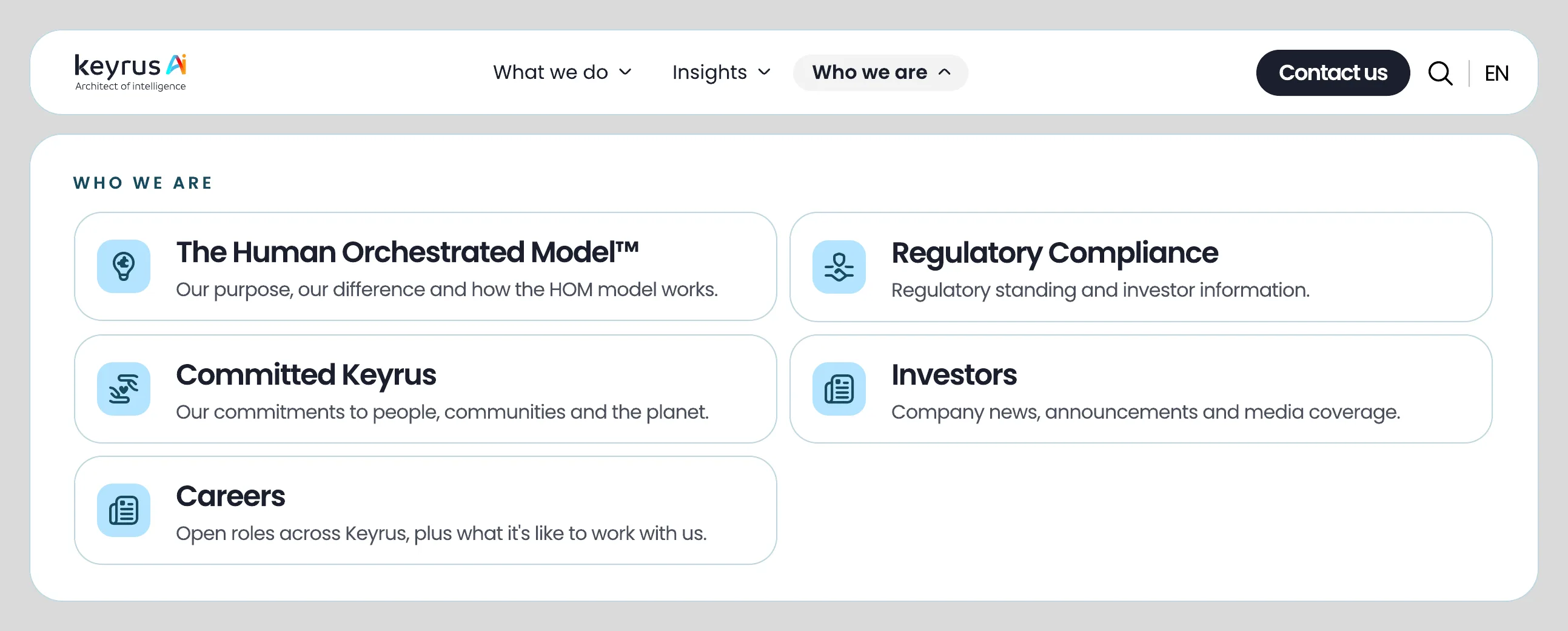
The eight panels stacked at full resolution on the design board.
HOM becomes the backbone of the site
The corporate presentation V1 (June 2026) sets the narrative: Architect of intelligence, carried by the Human Orchestrated Model™. The site must reflect this architecture: HOM's 3 layers, the portfolio of 4 capabilities, and the taglines sprinkled across all pages. It's also the GEO lever: a proprietary, structured narrative is exactly what AI engines reproduce best.
The 3 layers of the Human Orchestrated Model™
Continuously steer decisions and execution toward measurable business impact. Proof: 12 % less spend on operations for a video giant.
Who decides, who governs, who's accountable: clear human oversight and pragmatic governance. Proof: 100 % ROI on a European bank's first GenAI programs, 20+ use cases.
Structure, activate and govern data and agents: the foundation for deploying AI at scale. Proof: $5M+ saved per harvest at an agribusiness producer.
Portfolio: 4 composable capabilities
The narrative's taglines, to highlight and sprinkle across the whole site (hero, sections, CTAs, offer pages).
Open thinking: making HOM demonstrable
The concern raised by the exec team: the positioning is a little too intellectual. HOM and “architect of intelligence” land at manifesto level, and the business directions need real examples to see themselves in it. Not decided, and not blocking the build.
Start with Finance: translate concrete pains into HOM solutions with measurable outcomes. A website module and a sales asset at once.
They win on concreteness and a clear pain-to-solution story. Borrow that rather than stay at concept level.
An AI operating system inside HOM: deploy and orchestrate agents with the human in command. Gives the abstract idea a demonstrable anchor.
L2 is the differentiator and the hardest to show. The audit below flags thin proof on agentic use cases and AI governance.
1,087 existing pieces of content, already mapped to HOM
The full portfolio audit (Jesse, June 2026): 553 blog insights, 434 key plays, 100 EPM pages. The 677 thematic content pieces spread across HOM's 3 layers in a balanced way (39 / 30 / 31 %): HOM isn't a narrative to fill in, it's a grid that structures editorial capital that's already there. The remaining 410 (136 industries, 85 events, 69 corporate, 19 client cases, 101 out of scope) cross-tag to a pillar or fall outside scope.
Mix by HOM layer 677 thematic content items
The blind spots the grid reveals To fill
- Semantic enablement & knowledge graphs : an official HOM capability, zero content. The portfolio's clearest white space.
- Agentic & autonomous AI : 30 insights but 4 key plays. We talk about it without proving it: critical for an "Architect of intelligence" positioning.
- AI governance, ethics & responsible AI : 8 pieces of content, no key play. The corporate portfolio's Trust & Governance pillar with no client proof.
- Planning, FP&A & predictive models : 38 key plays but 5 insights. The reverse: proof without thought leadership, an EPM lane to activate.
| Layer | Sub-theme | Insights | Key plays | Total |
|---|---|---|---|---|
| L1 | Data platforms & cloud architecture | 83 | 57 | 140 |
| L1 | Governance, trust & responsible data | 56 | 17 | 75 |
| L1 | Data products, monetisation & DataOps | 21 | 9 | 30 |
| L1 | Cybersecurity & resilience | 11 | 5 | 17 |
| L1 | Semantic enablement & knowledge graphs White space | 0 | 0 | 0 |
| L2 | AI strategy, value & adoption | 59 | 28 | 89 |
| L2 | Generative AI, ML & LLM platforms | 24 | 11 | 37 |
| L2 | Talent, skills, AI literacy & change | 17 | 16 | 36 |
| L2 | Agentic & autonomous AI | 30 | 4 | 34 |
| L2 | AI governance, ethics & responsible AI | 8 | 0 | 8 |
| L3 | Analytics, BI & dashboards | 33 | 44 | 79 |
| L3 | Planning, FP&A & predictive models | 5 | 38 | 63 |
| L3 | Performance, profitability & EPM | 10 | 33 | 46 |
| L3 | Decision intelligence & insight-to-action | 12 | 10 | 23 |
This mapping changes the approach: HOM isn't landing on an empty site. Every surface (HOM, portfolio, industries, insights) can be linked from V1 to existing content tagged by layer, and the editorial calendar can be driven by the grid's gaps rather than ad hoc. That's decision D9.